
Hip hop is a culture-first movement built around DJing, MCing, dance, style, and community—not just rap. Its sound often comes from sampled breaks, drum machines, and a strong pocket for flow, but what really defines it is how music, language, and identity work together. This guide covers the origin story, the four elements, a beginner timeline, what hip hop sounds like, and a simple way to start making your own beat and rap ideas faster.
Hip hop is a global culture built from music, dance, visual style, and community—far bigger than any single sound on the radio. In this guide, you’ll learn what hip hop is (in plain English), where it started, the four main elements of hip-hop, and an easy way to start listening with confidence. You’ll also get a beginner timeline, a “what to listen for” checklist, and a simple workflow if you want to make hip hop yourself.
From here, we move from the broad definition into the practical part: how hip hop differs from rap, why the Bronx matters, and where MelodyCraft fits if you want to sketch a beat before you open a DAW.

What is hip hop (and why do people say it’s more than rap)?
What is hip hop? Hip hop is a cultural movement and creative practice that includes (but isn’t limited to) rap music—shaped by community, competition, style, and storytelling. If you’ve ever heard someone say “hip hop is more than rap,” they’re pointing to the fact that rap is one expression inside a larger culture.
For a deeper cultural overview, this explainer on what hip hop is captures the idea that hip hop grew from real-life spaces and real communities, not just studio releases.
One-sentence definition + 3 key traits (save this):
Definition (1 sentence): Hip hop is a culture that turns rhythm, language, movement, and style into a shared identity and art form.
Trait #1 — Community-first: built in public spaces (parties, parks, streets, community centers).
Trait #2 — Skill + competition: battles, cyphers, and friendly rivalry push innovation.
Trait #3 — Remix mindset: reusing, flipping, and recontextualizing sounds, moves, and visuals.
In practice, hip hop commonly shows up as:
Music: DJing and MCing (rap)
Dance: breaking and related party styles
Visual art: graffiti writing
Social norms: slang, fashion, values, and “how you carry it”
Hip hop vs rap: what’s the difference in plain English?
People often use the terms interchangeably, but rap vs hip hop is easiest to understand as a technique vs a culture.
So rap is part of hip hop, but not all hip hop is rap. You can attend a breaking battle, paint letters, or DJ a break-heavy set and be participating in hip hop without rapping at all.
Why do people argue about labels (like whether rap rock “counts”)? Usually because labels do two jobs at once: they describe sound and they signal identity/community. Some fans focus on musical traits; others focus on whether something is connected to hip hop’s roots, spaces, and practices. If you want a quick mainstream-friendly framing, this overview of the difference between hip-hop and rap matches the “subset vs set” idea many listeners mean.
Where did hip hop originate? A quick origin story (Bronx, 1970s)
If you’re asking where did hip hop originate, the short answer is: New York City—especially the Bronx—in the 1970s. The longer (more useful) answer is that hip hop formed where social pressure met creative problem-solving: tight budgets, limited access to formal music training, and neighborhood gatherings turned into a new kind of live, participant-driven art.
Instead of starting as a “genre” in record stores, hip hop started as an event: block parties, recreation rooms, and community spaces where DJs experimented with sound systems and records. DJs learned that dancers reacted hardest to the break—the most rhythmic part of a song—so they found ways to extend it and keep the energy going.
That live feedback loop mattered:
DJ techniques shaped what people danced to
Dancers shaped which parts of records got emphasized
MCs evolved from hyping the crowd to delivering rhythmic, structured verses

Why DJ Kool Herc is often credited as a founder of hip hop
You’ll often see DJ Kool Herc described as a founder figure because of his early role in popularizing break-focused DJing at Bronx parties. A careful way to say it is: he’s widely credited as a key originator, not the only inventor—hip hop is a collective creation shaped by many artists and neighborhoods over time.
Encyclopedic sources like Britannica’s profile of Kool Herc reflect this “credited as” framing: it acknowledges his influence without pretending the culture sprang from a single person.
A simple cause-and-effect chain helps:
What he did: emphasized and extended breakbeats by switching between copies of the same record (so the break kept looping).
What it changed: dancers got longer, cleaner rhythmic sections to innovate with.
What it enabled: MCs had more predictable pockets to hype, then rhyme—helping MCing evolve into rap performance.
When you listen to early break-focused sets, try counting “1–2–3–4” and notice how the break feels like the track’s gravitational center—everything else is built to keep you there.
What are the four main elements of hip-hop?
The four elements of hip-hop most commonly taught are DJing, MCing, breaking, and graffiti writing. Some communities add a “5th element” (often knowledge), and there are always debates about what belongs. Still, these four pillars remain the most widely referenced set—including in definitional references like Britannica’s explanation of the four main elements.
Here’s the practical way to think about them: each element is a different answer to the same question—how do we move a crowd and express identity with limited resources? One uses records, one uses voice, one uses bodies, one uses public surfaces.

DJing (turntablism): breaks, scratching, and why the DJ came first
DJing (and later turntablism) is the backbone of hip hop’s earliest sound. In the simplest terms, DJs learned to control energy by controlling time—choosing which seconds of a record people heard, and how long they stayed there.
Key terms, without the jargon overload:
Break: the drum-heavy section that makes you want to move immediately.
Breakbeat: a beat built around (or inspired by) those break sections.
Cutting: switching between records to keep the groove continuous.
Scratching: moving the record under the needle rhythmically for a percussive “shh-krk” texture.
If you’re new, don’t worry about naming techniques—listen for the feel: the DJ is “conducting” the room by repeating the most danceable moments until the crowd locks in.
MCing (rapping): flow, rhyme, and storytelling
MCing is where rap technique lives: rhythm, rhyme, and performance choices that make words hit like drums. New listeners often ask how to “measure” skill—especially when styles differ wildly. A useful way is to listen for three layers:
Rhythm control (flow): does the rapper land confidently on or around the beat?
Language craft (rhyme + wordplay): are the patterns intentional and surprising?
Communication (story + presence): do you feel personality, stakes, or imagery?
Mini example: end rhyme vs internal rhyme (toy demo):
End rhyme:
I came with a plan / and I’m taking a stand
Internal rhyme:
I came with a plan, let it rain in the land where I’m staying—I can’t understand
Internal rhyme often feels “faster” or more musical because the echoes happen inside the line, not only at the end.
Breaking (b-boying/b-girling): dance as competition and community
Breaking (b-boying/b-girling) is not just “hip hop dance” in general—it’s a specific style with its own vocabulary and battle format. It grew as a physical response to breakbeats: when the DJ extended the break, dancers had room to invent footwork, freezes, and power moves.
Two cultural ideas matter as much as the moves:
Battles: competitive exchange that rewards originality and control, not just difficulty.
Cyphers: circles where dancers take turns, learn from each other, and build community.
If you’re watching for the first time, focus on musicality: how the dancer “answers” kicks, snares, and accents with timing choices.
Graffiti writing: style, tagging, and the debate around public space
Graffiti writing is hip hop’s visual language—often letter-based, style-driven, and identity-forward. It overlaps with street art, but graffiti’s classic focus is name style (tags, throw-ups, pieces) and how letters evolve through competition and innovation.
A balanced way to understand it:
As culture: it’s a public signature, a style battle, and a way to be seen.
As law: it can carry real legal consequences and conflicts over public/private space.
If you’re inspired by graffiti aesthetics, start legally (sketchbooks, canvases, approved walls). The culture values style and consistency—but the risks of illegal painting are not theoretical.
Is there a “5th element” of hip hop (knowledge/beatboxing)?
Some people talk about a 5th element of hip hop—most commonly knowledge (history, self-awareness, community responsibility). Others point to beatboxing as an additional element because it expands rhythm-making beyond records and drums.
The safest way to hold this debate is: different scenes emphasize different foundations. The “four elements” are the most standardized teaching set; “knowledge” is often treated as the glue that keeps those elements connected to purpose rather than just aesthetics.

Need a faster way to sketch hip hop ideas?
Turn a drum pattern, sample mood, and vocal vibe into a usable draft in MelodyCraft in minutes.
A beginner-friendly hip hop history timeline (1973 → streaming era)
Hip hop history is huge, so here’s a 10-node timeline you can actually remember. If you want to dig deeper into regional development, this timeline-focused resource on East Coast hip hop history is a helpful jumping-off point.
1973 — Bronx parties go break-focused.
DJs discover the break is the emotional peak, and party culture becomes the lab for innovation.
Late 1970s — MCing becomes structured.
Crowd-hype evolves into patterned rhymes and call-and-response routines.
1979 — Recorded rap breaks into the mainstream.
Vinyl releases prove the style can sell beyond live events—and change what “success” looks like.
Early 1980s — Turntablism and scratching gain identity.
The DJ becomes not just a selector but a performer with signature sounds.
Mid–late 1980s — Albums become statements.
Longer projects expand storytelling, social commentary, and sonic experimentation.
1990s — “Golden age” craft levels up.
Sampling artistry, lyrical density, and regional identities intensify.
1990s — Regional scenes harden.
East/West/South (and beyond) develop distinct sounds and industry pipelines.
2000s — Club influence and radio polish rise.
Hooks, bounce, and production trends push rap further into pop structures.
2010s — Trap and internet distribution reshape the center.
New drum patterns, faster trend cycles, and streaming-first discovery dominate.
2020s — Algorithm era + micro-scenes.
Global sounds hybridize; niche communities thrive alongside mainstream hits.
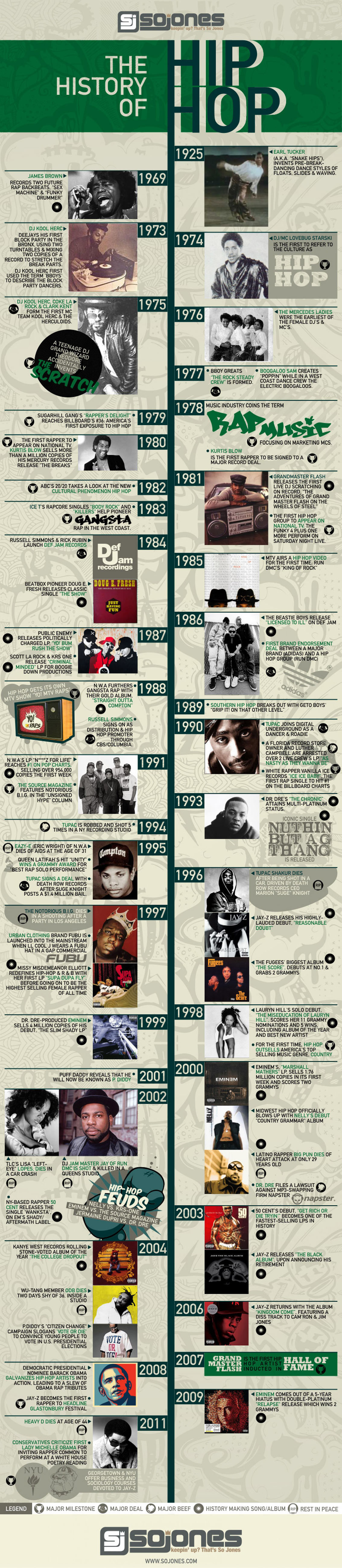
The Bronx block-party era and the birth of break-focused DJing
Early hip hop history makes more sense if you follow the live chain reaction rather than a list of dates. DJs extended breaks to keep dancers moving; dancers pushed the energy higher; MCs had to evolve from simple chants to more rhythmic, memorable phrases so they could cut through the noise.
That’s why it’s fair to say the culture came before the recordings. Hip hop didn’t begin as a product—it began as a practice, refined in front of people who responded immediately.
The first commercial breakthroughs and why recordings changed the culture
When people ask for the first hip hop song, they’re usually mixing three different questions:
What was the first commercial breakthrough?
What was the earliest rap recording?
What was the first hip hop culture moment (live, local, community-based)?
Those don’t always point to the same answer, and that’s why “first” is often debated. What recordings definitely changed was scale: once rap lived on vinyl (and later radio/TV), success moved from “rock the party” to “reach the market,” which influenced style, length, and even what voices labels chose to promote.
How hip hop expanded: golden age, regional scenes, and mainstream moments
Hip hop expanded in three big waves that still shape what you hear today.
First, a craft boom: sampling got more ambitious, drum programming got sharper, and lyric approaches multiplied (battle rap, storytelling, humor, social critique). Second, regional differentiation: production choices and vocal rhythms shifted by city and scene, creating recognizable identities even before you knew artist names. Third, mainstream moments: as hip hop became pop’s engine, it absorbed (and was absorbed by) other genres, changing industry expectations around hooks, tempos, and crossover appeal.
What does hip hop sound like? The musical building blocks
If you’re new and wondering what hip hop “sounds like,” listen for four building blocks: rhythm, sampling/texture, bass weight, and tempo pocket.
Rhythm: strong kick/snare patterns that leave space for vocal rhythm.
Texture: samples, synth lines, chopped vocals, or sparse melodic loops.
Bass: sub-heavy low end (especially in modern styles) that carries the body feel.
Tempo range: many classics sit around 80–100 BPM (or double-time feel), while modern trap often feels like 130–160 BPM with halftime drums.
A helpful listening trick: decide what’s “leading” the track—drums, bass, sample, or vocal. Hip hop production often rotates that leadership across sections.
Sampling, drum machines, and the ethics behind “borrowing”
Sampling is one of hip hop’s signature creative methods: taking existing audio and transforming it into something new through looping, chopping, pitching, and layering. Artistically, it’s closer to collage than copying—your skill shows in choice and context, not just originality-from-zero.
But sampling also creates real-world friction because recorded music has owners. This isn’t legal advice, but here’s the practical idea: if you use someone else’s recorded sound, you may need permission—especially if you release music commercially.
Three common sampling approaches (creative, not legal categories):
Direct sampling: lift a section of audio and build around it.
Replay (interpolation): re-record a similar part with new performance.
Chop and recompose: slice tiny fragments and rearrange into a new melody/rhythm.
If a sample “doesn’t sit,” shorten it until it feels like a texture, then let your drums and bass create the main identity.
Flow and rhyme: what listeners mean by “bars,” “pocket,” and “cadence”
Here’s a small dictionary for how fans talk about rap performance:
Bars: usually a unit of time (measures) and, by extension, the lines delivered in that space.
Pocket: where the vocal rhythm sits against the beat (slightly ahead, behind, or dead-center).
Cadence: the pattern and shape of delivery—how syllables rise/fall and repeat.
How to listen (simple method):
Hear the kick and snare as your “grid.”
Notice where the rapper places stressed syllables.
Listen for changes between sections (verse vs hook) and how cadence signals emotion.
This is why two rappers can use similar rhyme density but feel totally different: they’re choosing different pockets and cadences.
Hip hop subgenres and regional styles (so you can find your lane)
Hip hop subgenres are best used as discovery tools, not argument weapons. Instead of obsessing over perfect boundaries, use subgenres to answer: What will it sound like? and What mood does it fit?
Here’s a beginner-friendly “find your lane” table:
Boom bap, trap, drill, conscious, alternative: quick definitions
Boom bap: Classic drum-forward hip hop with a tight kick/snare snap and a “swinging” head-nod feel. A typical trait is a looped sample that runs like a spine through the verse.
Trap: A modern production approach centered on 808 bass, crisp snares/claps, and fast hi-hat rolls. The arrangement often uses space—letting the low end and vocal cadence carry the hook.
Drill: A darker, more menacing cousin to trap in many scenes, often with tense melodic loops and more aggressive rhythmic phrasing. A common sonic marker is stabbing, syncopated drum movement under a cold, minimal melody.
Conscious hip hop: Not one drum pattern—more a lyrical and thematic focus on social reality, reflection, and community. The “sound” can vary, but the typical trait is message clarity and narrative intent.
Alternative hip hop: A wide umbrella for artists who bend conventions—unusual samples, odd structures, or genre crossovers. A typical trait is unexpected texture (off-kilter drums, indie synths, jazz harmony, etc.).
East Coast vs West Coast vs Southern hip hop: what changes musically?
Regional labels shift by decade, but they’re still useful if you listen in four dimensions: drums, bass, sampling, and vocal rhythm/accent.
East Coast hip hop: often drum-forward with crisp snares, dense sample work, and lyric complexity in the pocket. The rhythmic feel can be tighter and more “percussive” in delivery.
West Coast hip hop: historically associated with smoother, funk-influenced grooves and a laid-back bounce; production often emphasizes ride and roll rather than sharp chops.
Southern hip hop: frequently bass-heavy with strong groove emphasis—ranging from party bounce to darker, sparse modern styles. Vocal rhythm can lean into drawl, swing, and chant-like hooks that hit hard live.
The key reminder: regions aren’t static. A modern “South” track might be global-influenced; an “East” track might be melodic trap. Use labels as starting points, not rules.
How to get into hip hop: a listening roadmap for beginners
If you want to get into hip hop without feeling overwhelmed, you need a plan that matches how you actually enjoy music. Here are three easy paths—pick one for two weeks, then branch out.
By era (history-first): start with early party roots → classic album era → modern streaming sounds.
Best if you like context and want to “hear the evolution.”
By style (sound-first): boom bap → trap → drill/alternative, based on what clicks immediately.
Best if you want fast enjoyment with minimal homework.
By theme (lyrics-first): storytelling, battle rap, feel-good anthems, social commentary.
Best if words and personality pull you in more than production.
Albums vs playlists? Both are useful—but they teach different things. (More on that below.)

A simple checklist: what to listen for in a great hip hop track
Use this checklist like a scorecard (1–5 each), especially when you’re building your taste:
Beat: Are the drums clean? Does the groove make you move?
Hook: Is the chorus memorable or emotionally sticky?
Verses: Do the bars develop ideas, not just fill time?
Delivery: Does the voice sound confident in the pocket?
Story/imagery: Do you see scenes, feel stakes, or learn something?
Replay value: Would you run it back immediately?
Try listening twice: first for drums + bass, second for vocal pocket. Your favorites often “lock” on both passes.
Albums vs playlists: how hip hop is meant to be experienced (and why both matter)
Hip hop albums often capture an era: shared sounds, themes, local slang, and what mattered at the time. Albums also reward attention—sequencing, interludes, and contrast between tracks can deepen the story and make the best verses hit harder.
Hip hop playlists are unbeatable for discovery: they let you compare flows, hooks, and production trends quickly. The trade-off is context—playlists can flatten differences between scenes, years, and subgenres.
If you’re new, use a hybrid routine:
Weekdays: playlists to discover voices and sounds
Weekends: one album front-to-back to learn pacing and identity
Hip hop as a culture: dance, fashion, language, and community norms
Hip hop culture travels through more than songs. You’ll see it in how people move (dance), how they dress (fashion), how they speak (slang and cadence), and how communities enforce values like skill, originality, and respect.
Beginner-friendly ways to participate (without pretending you “know it all”):
Watch a breaking battle or DJ set and notice how the crowd responds
Go to local shows (or open mics) and learn what the room rewards
Learn the basics of the four elements so you don’t reduce it to just chart hits
Respect context: slang, symbols, and stories often come from real experiences
Why authenticity debates (“keeping it real”) keep coming up
Authenticity arguments keep surfacing because hip hop is both art and identity—and money changes how identity gets marketed. When people debate “keeping it real,” they’re often debating one of these tensions:
Commercialization: does chasing hits dilute the message or craft?
Region: does an artist represent a place honestly or imitate trends?
Class: who gets access to studios, marketing, and visibility?
Identity: who gets to tell which stories, and how?
A useful way to navigate this as a listener is to separate:
Authenticity of craft (skill, originality, musical intent)
Authenticity of narrative (truthfulness, perspective, accountability)
You can appreciate innovation while still being critical of marketing stories that feel manufactured.
Want to make hip hop? A beginner workflow (beat + rap)
If you want to make hip hop, think in the smallest complete loop: beat idea → 8 bars → rough recording → revise. You don’t need perfect gear to start—you need repetition and a way to finish sketches.
A minimal beginner workflow:
Pick a tempo and drum feel (boom bap swing? trap halftime?)
Build a 4–8 bar loop (drums + bass + one main sound)
Freestyle or write a rough verse to find your pocket
Rebuild the beat around your vocal rhythm (not the other way around)
Arrange into a simple structure (intro → verse → hook → verse → outro)
Export a demo and take notes on what feels weak (hook? drums? delivery?)
If you want a fast way to turn rough ideas into listenable demos, MelodyCraft can help you generate beat directions and iterate quickly—so you spend more time writing and performing, less time stuck on a blank project.
How to make a hip hop beat in 6 steps (kick, snare, hats, bass, sample, arrangement)
Here’s a practical hip hop beat workflow you can repeat—each step includes a common beginner pitfall.
Kick: choose a kick that matches the vibe (punchy for boom bap, deep for trap).
Pitfall: kick fights the bass—leave space or sidechain lightly.
Snare/Clap: place the backbeat confidently (classic feel often hits on 2 and 4).
Pitfall: snare too loud—hurts the vocal pocket later.
Hi-hats: set motion (steady groove, swing, or rolls).
Pitfall: overprogramming—if everything moves, nothing feels special.
Bass/808: lock with the kick rhythm and support the hook.
Pitfall: notes too busy—simple bass often hits harder.
Sample or main melody: pick one identity sound and commit.
Pitfall: stacking too many loops—your track loses a “face.”
Arrangement: build contrast (drop elements out, add ear candy, change drum density).
Pitfall: looping forever—copy sections, then edit down.
Common BPM ranges (as a starting point):
Boom bap: ~85–95 BPM (or 170–190 double-time feel)
Trap/drill: ~130–160 BPM (often halftime drums)
How to write rap lyrics: finding your pocket, rhyme schemes, and storytelling
Writing rap lyrics gets easier when you stop trying to write “a whole song” and focus on one repeatable unit: 8 bars.
The 8-bar practice (do this daily for a week):
Pick one topic: a moment, a place, a feeling, a conflict.
Write 8 bars with simple end rhymes (don’t overthink).
Read it over the beat and mark where you run out of breath.
Replace two lines with internal rhymes or multi-syllable rhymes.
Perform it twice: once on-beat, once slightly behind the snare (feel the difference).
Keep the best 2 bars as “seed lines” for future verses.
Tiny example (multi + internal rhyme, self-written): In the back of the bus, I was stacking up trust, Now the track got a pulse and it’s cracking the dust.
Notice how the repeated “a” sounds connect across the middle of the line, not just the end.
If your lyrics look good on paper but feel awkward out loud, it’s usually a pocket problem—change syllable count, not the idea.
FAQ: the most-asked questions about hip hop
Who invented hip hop?
Q: Who invented hip hop?
A: Hip hop wasn’t invented by one person—it emerged from a community of DJs, dancers, MCs, and writers. That said, DJ Kool Herc is often credited as a key founder figure because of his early break-focused DJing influence, a framing reflected in references like Britannica’s Kool Herc biography.
Why is it called hip hop?
Q: Why is it called hip hop?
A: There isn’t one universally proven origin story for the term, and many accounts are partly oral history. Common explanations include it imitating rhythmic speech (“hip/hop” as movement) and evolving from early scene slang and chants; over time, the name stuck as the culture gained visibility (see broader cultural summaries like this hip hop guide).
Is rap part of hip hop?
Q: Is rap part of hip hop?
A: Yes—rap (MCing) is one element within hip hop, while hip hop includes other elements and cultural practices. A quick way to remember it: rap is a performance technique; hip hop is the larger cultural umbrella (similar to how this hip-hop vs rap explainer frames it).
What was the first hip hop song?
Q: What was the first hip hop song?
A: “First” depends on what you mean: the first commercially successful rap record, the earliest recorded rap performance, or the earliest live hip hop culture moment. Many timelines focus on commercial breakthroughs because they’re easier to document—resources like this hip hop history reference provide context for how recordings changed the culture: history of East Coast hip hop.
Q: What are the four main elements of hip-hop?
A: The most commonly cited four are DJing, MCing (rapping), breaking, and graffiti writing. Some people add a “5th element” like knowledge, but the four-element framework is the standard baseline (see Britannica’s four elements answer).
Q: Where did hip hop originate?
A: Hip hop originated in New York City, especially the Bronx, in the 1970s, growing from block parties where DJs, dancers, and MCs shaped the culture together.
Make hip hop-ready music faster
Go from idea to a draft you can refine for beats, bars, or content clips.