
Sleep music works best when it is stable, low-detail, and matched to the problem you’re trying to solve—noise masking, anxiety reduction, or a wind-down routine. If you want to make a custom track instead of relying on playlists, MelodyCraft can help you build one faster. This guide shows what to choose, what to avoid, and how to set up a night routine that actually sticks.
Below, we move from the theory of masking and regulation to the practical choices that change the outcome: which sounds are steady enough for sleep, how long a playlist should be, and where MelodyCraft fits if you want a custom track instead of searching for one.

Does sleep music actually help you fall asleep faster—or is it just masking noise?
Sleep music helps in two main ways: masking and regulation. Masking means it covers unpredictable background sounds so your brain stops “checking” the environment. Regulation means it helps your nervous system downshift—slower breathing, less muscle tension, fewer anxious thought loops. The best overview of how sound interacts with sleep is summarized by the Sleep Foundation’s guide to music and sleep.
Two common “sleep music” user types
1) The masker (noise-sensitive sleeper) You wake up to small changes: a door, a car, a distant conversation. For you, the win condition is consistency. Nature loops, pink/white noise, fan-like sounds, or steady ambient textures often beat “pretty” music.
2) The mind-settler (anxiety / racing thoughts) Silence makes your brain loud. For you, the win condition is attention relief: something gentle enough to rest your mind on without pulling you into analysis. This is where low-detail ambient music, simple piano patterns, or sleep meditation can help.
How to tell it’s working (and when it’s not)
Signs sleep music is helping
You feel less alert within ~10–20 minutes (heaviness, slower blinking, less urge to check the time).
You’re not tracking the music; it becomes “background.”
Your night-to-night routine feels easier even if you still have imperfect sleep.
Signals it’s backfiring
You keep switching tracks or “chasing” the perfect sound.
You notice emotional spikes (nostalgia, sadness, excitement).
You’re lying there thinking, “This isn’t working,” and feel more awake.
Use the same track or sound for 5–7 nights before judging it. Your brain often needs repetition to associate that sound with sleep.

What people report in real life: rain sounds, white noise, and low-volume playlists
In real-world sleep communities, people tend to rotate between three practical setups: steady rain, white/pink noise, and low-volume “sleep playlists.” If you browse threads like this discussion on what people use for sleep sounds, you’ll see a consistent theme: individual difference matters more than the “perfect” audio genre.
A common pattern looks like this:
Rain / ocean / fan when the goal is “block outside noise and stop micro-waking.”
White or pink noise when the sleeper wants the most predictable sound possible.
Gentle music (often lyric-free) when the goal is “calm my nervous system and stop overthinking.”
The most useful takeaway: don’t over-optimize. Pick one sound type, keep it consistent, and focus on whether it reduces friction at bedtime—not whether it’s aesthetically “the best.”
What kind of sleep music is best (tempo, instruments, lyrics, and volume)
The best sleep music is usually slow, repetitive, low-contrast, and non-distracting—more like a calm atmosphere than a song you’d put on during the day. Many “best music to fall asleep to” recommendations converge on similar traits, including avoiding stimulating changes and choosing gentle timbres (see Calm’s practical breakdown of music to fall asleep to).
Here’s a simple, actionable selection checklist you can use tonight:
Volume rule of thumb: set it so you can still notice it if you pay attention, but you don’t have to “follow” it. If you can clearly identify every instrument, it’s probably too loud (or too detailed).
Is it bad to sleep with music on all night? (fade-out vs loop)
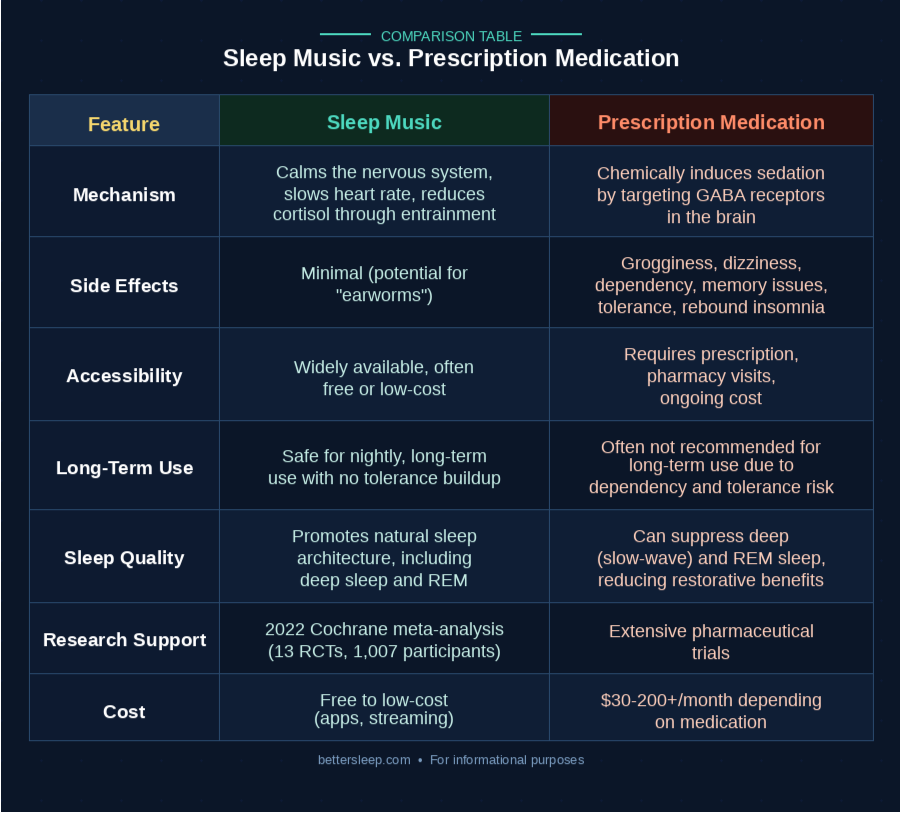
Whether you should keep sleep music on all night depends on why you’re using it.
If your goal is falling asleep faster, you usually want fade-out or a timer so sound doesn’t become something your brain monitors.
If your goal is masking ongoing noise, all-night playback can be helpful—especially with steady sounds that don’t change volume or arrangement.
A practical way to choose is to test these three strategies for 3–4 nights each:
1) 15–30 minutes (quick sleep onset) Best for: overthinkers who only need help “crossing the bridge” into sleep. How: choose one track, set a timer, fade out.
2) ~90 minutes (one sleep cycle) Best for: people who fall asleep fine but wake during the first cycle. How: use a seamless loop or long ambient track, then fade.
3) All night (masking environment) Best for: traffic, roommates, city noise, snoring. How: use stable noise/nature sound with no noticeable transitions.
If you wake up when the track ends, you may be using the audio as a sleep “anchor.” Try a longer timer (90 minutes) or a more continuous sound (fan/rain) instead of repeating short songs.
Headphones or speakers: what’s safer and more comfortable for sleep?
If you’re asking this, you’ve probably already experienced it: headphones can be great at low volume, but uncomfortable (or risky) once you actually fall asleep.
Headphones: pros and cons
Pros: more private, better detail at lower perceived volume.
Cons: discomfort for side sleepers, possible ear irritation, tangling risk with wired models, and you may turn volume up unintentionally.
Speakers: pros and cons
Pros: more comfortable, easier to keep volume low, fewer “in-ear” issues.
Cons: may disturb a partner; placement matters.
Comfort-first alternatives (often best for sleep)
A small bedside speaker angled away from your partner.
A “directional” mini speaker placed on a nightstand closer to you.
A soft headband-style sleep headphone (if you must use headphones), with a strict low-volume habit.
Placement tip: keep the sound source close to you, so you can use lower volume and reduce stimulation.
Sleep meditation vs sleep music: when each works best
Sleep meditation and sleep music overlap, but they solve different problems. Sleep meditation is more “active”—it guides attention, breathing, or body scanning. Sleep music is more “passive”—it sets a stable sensory environment. If you’re also improving overall sleep hygiene (light, schedule, caffeine), general tips like Healthline’s evidence-informed sleep advice pair well with either tool.
Use this quick comparison to decide:
If your mind won’t shut off: try a short sleep meditation first, then switch to music
If you tend to “think your way awake,” this combo is often more reliable than music alone: 5–10 minutes of guided downshifting, then 20–40 minutes of lyric-free sleep music with a fade-out.
Here’s a simple bedtime script you can follow:
Set the room: dim the lights, put your phone face down, enable Do Not Disturb.
5 minutes: guided breathing (or box breathing if you already know it).
3 minutes: body scan—forehead, jaw, shoulders, belly, legs—release each area.
Switch: start your sleep music at low volume, set a 30–45 minute timer, fade out.
Rule: if you catch yourself judging the track, return to one sensation (breath or weight of the blanket).
What is sleep meditation music—and why it feels different from regular playlists?
Sleep meditation music is designed to be supportive, not interesting. Compared to a normal playlist, it tends to have fewer “events” that grab attention—less melody, fewer chord changes, and more continuous textures. Many sound-healing style tracks emphasize sustained tones and calming timbres (Verywell Mind offers an accessible overview of sound healing concepts and self-care framing).
Common elements you’ll hear in sleep meditation music:
Long ambient pads (a continuous “bed” of sound)
Soft bell/ bowl accents (sparingly, not rhythmic)
Nature layers (rain, wind, distant water)
Low-frequency warmth (felt more than noticed)
A useful mindset: treat it like lighting. You’re not trying to “watch” the light—you’re using it to change the room.
Binaural beats, delta/theta tracks, and “432 Hz”: what to know before you press play
These terms are everywhere in sleep meditation music. Some people find them relaxing; others feel nothing; a few feel uncomfortable (headache, irritation). The safest approach is to understand what you can reasonably expect—without turning it into a promise.
What you can expect
A structured sound that may make it easier to relax or focus attention.
A “ritual cue” effect: repeating the same track can become a sleep trigger.
What not to expect
A guaranteed medical effect, or a replacement for treating insomnia/anxiety.
One “magic frequency” that works for everyone.
Quick terminology reality check:
If you feel agitation, dizziness, or headaches—skip it and switch to simpler ambient pads or nature sounds.
Sleep and meditation music for anxiety: how to choose a track that won’t backfire
When anxiety is the problem, the wrong sleep and meditation music can accidentally keep you awake—especially if it carries strong emotion or too much narrative detail.
A “won’t backfire” selection approach:
Avoid lyrics (words are mental fuel when you’re anxious).
Prefer steady textures over expressive melodies.
Keep transitions minimal (no surprise chimes every 12 seconds).
If you like a pulse, make it soft and slow—something you can breathe with.
A useful pairing is breath pacing + music: inhale for ~4 seconds, exhale for ~6 seconds, and let the track be background “support,” not the main event.
A simple 3-step routine: breathe, scan, then let the music fade out
If you want something you can do even when you’re exhausted, use this:
1) Breathe (2 minutes) Inhale through the nose. Exhale a little longer than the inhale. Keep it easy—no forcing.
2) Scan (3 minutes) Relax the jaw. Drop the shoulders. Soften the hands. Unclench the stomach. Let the bed hold your legs.
3) Fade (20–40 minutes) Start sleep music at low volume, set a timer, and choose fade-out (not abrupt stopping). If your mind wanders, label it “thinking,” then return to breath.
How long should your sleep playlist be (15 minutes, 90 minutes, or 8 hours)?
Playlist length should match your goal—otherwise you’ll accidentally create new problems (like waking when the music stops).
Choose 15–30 minutes if you mainly need help falling asleep.
Best with: gentle, lyric-free sleep music and a smooth fade-out.
Choose ~90 minutes if you often wake during the first part of the night.
Best with: long ambient tracks or seamless loops that don’t “announce” a track ending.
Choose 8 hours if you need consistent masking all night (city noise, snoring).
Best with: stable white/pink noise or nature loops with minimal variation.
If you’re unsure, start with 30 minutes for a week. It’s the easiest setting to test without building an all-night dependency.
Music vs white noise vs nature sounds: which is better for light sleepers?
Light sleepers usually benefit from sounds that are predictable and stable. The more “meaning” or variation a sound has, the more likely your brain is to monitor it.
Here’s a quick way to choose:
White/pink noise: most consistent; best for masking sudden changes.
Choose this if you wake easily to bumps, voices, or doors.
Nature sounds (rain, ocean): comforting and still fairly stable, but can contain noticeable variation.
Choose this if pure noise feels harsh or irritating.
Music: can be calming, but melody/harmony changes can become attention hooks.
Choose this if you find it emotionally soothing and you don’t end up listening actively.
If you’re a light sleeper and you love music, try “music-like” soundscapes: ambient pads + soft texture, minimal melody, no lyrics. Community anecdotes in threads like this sleep sounds discussion often show people migrating toward simpler, steadier sounds over time—especially after repeated wake-ups.
Can sleep music become a crutch? How to avoid dependency and still use it effectively
Sleep music can become a psychological “must-have” if your brain starts believing silence equals danger or wakefulness. The fix isn’t to quit immediately—it’s to keep it tool-like, not requirement-like.
Try a gentle “de-dependence” plan:
Week 1: keep your routine, but lower volume slightly.
Week 2: shorten the timer by 5–10 minutes.
Week 3: use it every other night (especially on easier days).
Week 4: reserve it for high-noise nights or high-stress days.
The goal is flexibility: you can sleep with it, but you can also sleep without it.
Build your own sleep meditation music in minutes (custom tempo, no lyrics, seamless loop)
Most articles stop at “try this playlist.” The faster way to find what works is to build a track that fits your room, your sensitivity, and your brain. With a generator like MelodyCraft, you can create sleep meditation music that stays stable, avoids lyrics, and loops cleanly—so you don’t get startled by track transitions.
A good custom setup starts with a few parameters:
Tempo/BPM: very slow or no beat at all
Sound palette: warm pads, soft keys, light texture (no sharp attacks)
Nature layer (optional): rain or distant ocean at low level
Structure: minimal changes; no “drop,” no big chord lift
Length: 30 minutes (starter), 90 minutes (cycle), or 8 hours (masking)
Ending: fade-out for sleep onset; seamless loop for masking
Prompt template: generate sleep and meditation music for deep rest (3 examples)
Copy, paste, and tweak these English prompt templates to get sleep and meditation music that’s less likely to distract you.
1) Rain + gentle pad (best for: masking + calming)
Prompt: Create sleep meditation music at a very slow pace with no lyrics: warm ambient pads, soft rain texture, minimal movement, no sudden changes, smooth fade-out, 35 minutes.
Use when: you’re noise-sensitive but also anxious.
2) Ocean + no-melody atmosphere (best for: overthinkers)
Prompt: Generate deep sleep soundscape with no melody and no percussion: low warm drone, subtle ocean waves, consistent volume, seamless loop, 90 minutes.
Use when: your mind “grabs onto” melodies.
3) Singing bowl accents (best for: ritual cue)
Prompt: Make ultra-slow sleep meditation music: soft ambient bed, occasional gentle singing bowl hits (very sparse), no rhythm, no lyrics, low dynamics, 30 minutes, fade-out.
Use when: you like a gentle “bedtime signal” without a full meditation.
Free vs paid: what to check before downloading or using tracks commercially
Before you download sleep music (or use it in content), check a few practical items:
Usage rights: personal listening vs commercial use (especially for creators).
File quality: if you notice hiss or compression artifacts, it may keep you alert.
Customization limits: can you adjust length, loop, and fade-out?
Consistency: can you recreate a track style that works, not just browse endlessly?
If you’re comparing plans, start with what you actually need—testing, deeper customization, or commercial usage. You can review current options on MelodyCraft’s pricing page.
If sleep music isn’t helping after 2 weeks, try these fixes first
If you’ve tested sleep music consistently and it’s still not helping, don’t assume “music doesn’t work for me” yet. Most failures come from one of a few fixable issues:
Volume creep: you slowly raise it over nights until you’re listening instead of sleeping.
Too much variation: playlists with different tracks, intros, or ads cause micro-alerts.
Lyrics or emotional songs: your brain treats it like a story to process.
Device discomfort: earbuds, pressure points, or a bright screen when you adjust settings.
Bedroom basics ignored: light leakage, temperature too warm, or caffeine too late.
Pre-sleep stimulation: scrolling or intense content right before you hit play.
Use a simple reset: 1) Switch to one steady track or loop for 7 nights. 2) Lower volume by a noticeable notch. 3) Add a 5-minute wind-down (breathing or body scan) before pressing play. 4) If you’re still struggling, consider broader sleep habits from resources like the Sleep Foundation’s music guidance and general sleep tips such as Healthline’s sleep improvement checklist.
If you have persistent insomnia, panic symptoms at night, or daytime impairment, it may be worth speaking with a qualified clinician—sleep music can support sleep, but it shouldn’t be your only line of defense.

Make Ready-to-Publish Music in Minutes 🎵
Go from idea to finished track quickly. No technical skills required.