
The best study music is task-specific: what helps with flashcards can hurt reading, and what calms you down can still distract you if it has lyrics or too much novelty. This guide shows how to choose focus tracks by task, when lofi music works best, and how to build a background loop that stays under your work instead of pulling you into it. If you want a custom track instead of another playlist, MelodyCraft gives you a quick place to sketch one.
The sections below move from “does music help” into the practical part: how to match study music to reading, coding, memorization, and lofi-style focus sessions. If you want a custom background loop instead of another playlist hunt, MelodyCraft is a simple shortcut.

Does study music actually help you focus (or is silence better)?
Study music can help—but it can also quietly sabotage your concentration. Research and real-world experience generally point to the same boundaries: task type, personal preference, volume, and lyrics decide whether music supports focus or competes with it. A useful starting point is this overview from Healthline on music and studying.
Here’s a practical “yes/no” checklist you can use before you press play:
Study music tends to help when you’re:
Doing repetitive work (flashcards, light review, formatting notes) and need stamina
Studying in a distracting environment and want consistent background sound
Stressed or low-motivation, and music improves mood enough to keep you going
Silence (or simpler sound) tends to win when you’re:
Reading dense material (textbooks, papers) where comprehension is the goal
Writing or solving complex problems that require heavy working memory
Easily pulled by novelty (switching songs, noticing lyrics, anticipating drops)
If you’re unsure, start with silence for 3 minutes, then add low-volume instrumental study music. The contrast makes it obvious whether audio helps or hurts.
When study music helps: mood, stress, and study endurance
Study music often works best as an emotional regulator, not a “brain booster.” If a calm, predictable sound reduces stress, your study session usually lasts longer—especially during exam weeks or long revision days where endurance matters more than raw speed.
A simple self-check helps you choose the right direction:
Quick self-test: do you need stimulation or do you need noise control?
If you feel sleepy, sluggish, or avoidant, you may need light stimulation (steady beat, warm energy).
If you feel tense, overstimulated, or irritated by the room, you may need noise control (consistent background sound, fewer changes).
For long sessions, the hidden win is consistency: one stable “study music identity” (similar tempo, similar texture) reduces decision fatigue—so you spend less time skipping tracks and more time finishing work.
When study music hurts: reading comprehension, complex problem-solving, multitasking
Study music usually hurts when it steals the same mental resources your task needs. Two common failure modes:
Lyrics compete with language processing. If you’re reading, writing, or summarizing, your brain is already decoding language. Lyrics add another language stream—so comprehension drops or you reread lines more often.
Attention switching gets expensive. Complex problem-solving (math proofs, coding architecture, logic-heavy tasks) relies on keeping a mental model in working memory. Sudden musical changes (drops, vocal samples, switch-ups) trigger micro-switches that feel small but add up.
Clear rule you can trust: for reading and writing, prioritize no-lyrics study music (instrumental, ambient, soft classical, light soundtracks). If you still need masking, consider environmental audio (rain, café noise) or noise colors instead of “songs.”
What kind of study music works best for different tasks?
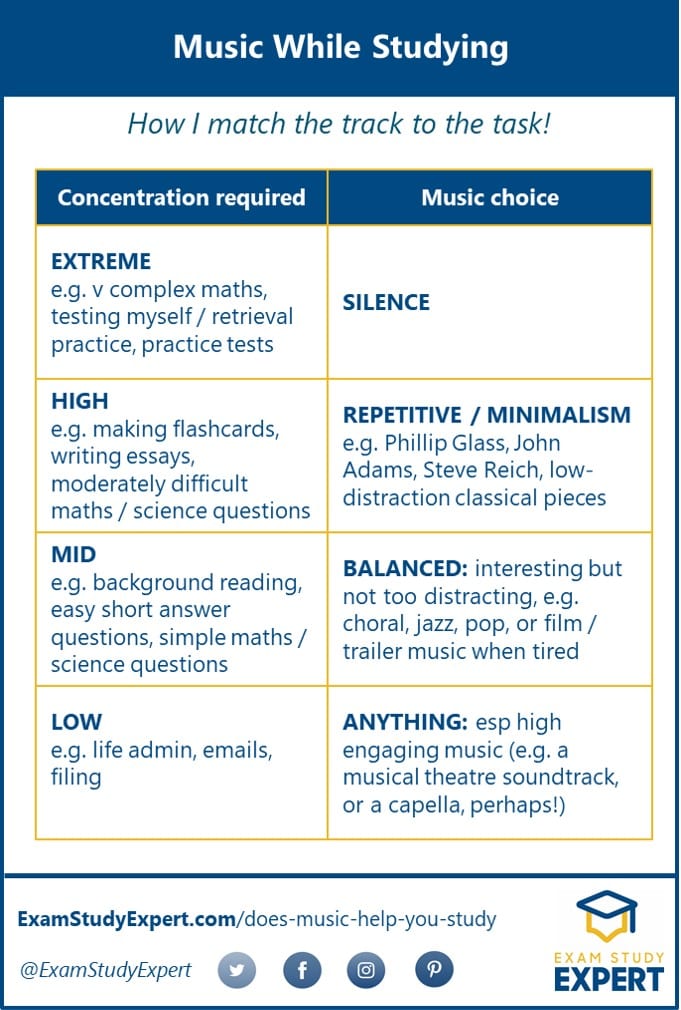
The most reliable approach is: pick study music by task, not by genre. A “great” track can be perfect for coding and terrible for reading—because your brain is doing different work.
Use these three features to evaluate any track quickly:
Vocals: none / minimal / full lyrics
Rhythm stability: steady / moderate variation / unpredictable
Dynamic range: small (even volume/energy) / medium / big jumps
Here’s a task-to-sound matching table you can apply to any playlist:
Study music for reading & writing: why instrumental usually wins
For reading and writing, instrumental study music usually wins because it stays “behind” your inner voice. A workable standard you can implement today:
No lyrics (or at least no intelligible vocals)
Low variation (same groove, similar instruments throughout)
Low volume (you can still “hear” your inner reading voice clearly)
Why are game and film soundtracks often recommended (even when they’re not labeled “study music”)? They’re frequently composed to support attention without demanding it—steady pacing, consistent tone, and fewer vocal-led hooks.
If you want a quick baseline: queue 10 minutes of instrumental music, start reading, and notice whether you’re re-reading sentences. If yes, simplify further (ambient / piano / soft pads).
Study music for math/coding: steady rhythms, low novelty
For math and coding, the enemy is novelty. Anything that makes you think “oh that’s cool” is also something that briefly steals attention from your mental model.
Use this filtering checklist for coding-friendly study music:
Choose tracks with long, stable sections (no frequent transitions)
Avoid big drum fills, aggressive snare hits, or sudden bass boosts
Watch for vocal samples (even one spoken line can break flow)
Prefer consistent tempo and soft transients (less “spiky” percussion)
A practical workflow: keep two playlists—one for deep coding (ultra-stable), one for debugging/review (slightly more energy).
Study music for memorization: tempo and repetition that doesn’t pull attention
Memorization benefits from rhythm and repetition—but not because a magical BPM makes you smarter. It’s because predictable repetition reduces cognitive overhead, letting you focus on recall.
What to look for:
A steady pulse you can ignore
Repetitive structure that doesn’t “ask” you to listen
Neutral emotion (not sad enough to slow you down, not hype enough to distract)
A surprisingly effective trick is conditioning: use the same looping background every time you do flashcards. Over time, your brain treats that sound as a “recall mode” cue—like a mental warm-up.

Need a custom study loop instead of another playlist?
Sketch calm, royalty-free background music for reading, coding, or flashcards in just a few clicks.
Is lofi music good for studying? What “lofi music” actually means
Lofi music can be great study music—but only when it stays truly in the background. First, what “lofi” actually means: it’s less about a strict genre and more about a sound aesthetic—often including gentle hiss/crackle, simple harmonies, and commonly (not always) a relaxed tempo range around 70–90 BPM. If you want a deeper definition and listening cues, this explainer on what lofi music is breaks down the core traits.
Why those traits often work for studying:
Simpler harmonic movement = fewer “look at me” moments
Small dynamic range = fewer volume surprises
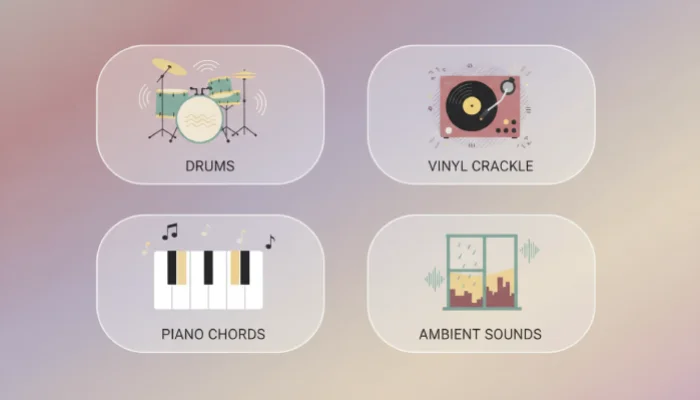
Textural noise (like vinyl crackle) can mask minor environment distractions (keyboard clicks, hallway sound) without turning into a “song you follow”
Why lofi music feels easier to ignore than pop songs
Pop songs are engineered to grab attention: vocals up front, memorable hooks, strong contrasts between verse and chorus. Lofi music often does the opposite: it’s intentionally understated, with fewer foreground elements competing with your task.
A simple listening test:
You should hear:
Soft drums that blend in
Warm chords, gentle melodies
A consistent mood that doesn’t change every minute
You shouldn’t hear:
Clear, singable lyrics
Dialogue snippets that trigger mental imagery
Sudden “drops” or dramatic transitions
If your brain starts predicting the next hook, it’s no longer background—it’s a second activity.
When lofi music becomes distracting (and how to fix it)
Lofi music becomes distracting in a few predictable “踩雷” scenarios:
Spoken-word samples or anime dialogue (your language brain locks on)
Drums too forward (the groove becomes the main event)
Loops that are too short (you start anticipating repetition)
Volume too high (especially boosted bass)
Fixes that work fast:
Switch to purer instrumental lofi (no dialogue, no vocal chops)
Lower the volume until it sits under your inner voice
Reduce low-end if possible (EQ: slightly cut bass)
Choose long mixes (60–120 minutes) rather than short 2-minute loops
Study music with lyrics: should you avoid it completely?
You don’t have to avoid lyrics completely—but you should treat lyrical study music as task-dependent. If the task relies on language (reading, writing, summarizing), lyrics are usually a net loss. If the task is more mechanical (filing notes, cleaning up citations, simple review), lyrics can be fine—sometimes even motivating.
A practical compromise when you really want songs:
Pick music you don’t know well (less sing-along risk)
Use a language you don’t understand (reduces semantic capture)
Keep volume low so vocals don’t dominate
This “it depends” framing aligns with broader discussions about when music supports focus versus disrupts it, like the guidance summarized in this study music overview.
A quick rule: if you can sing along, it’s not background anymore
If you can sing along, your brain is allocating attention to the track—no matter how “productive” it feels. Here’s an easy, repeatable test:
Start a 25-minute session.
At minute 5, ask: Am I following the words?
At minute 15, ask: Did I just replay a line in my head?
If either answer is yes, switch to instrumental study music, ambient sound, or noise.
Print this rule on a sticky note: “If I can sing it, I must swap it.”
Music vs white noise vs brown noise for studying: which one should you use?
If you’re choosing between study music and noise, the biggest difference is often not the “type”—it’s whether you have a consistent background layer at all. Noise can be especially helpful for masking sudden environmental interruptions (roommates, traffic, café chatter). For a good starting point on brown noise specifically, see this guide to brown noise for focus.
Use this comparison to decide quickly:
If you study in a quiet library, you may not need any of these. If you study in a noisy dorm, brown/pink noise often beats music because it has less semantic content to grab attention.
How loud should study music be (a practical baseline)
A good baseline is “background level”: it should not overpower your inner voice when reading. If you can’t silently mouth words in your head, it’s too loud.
Practical guidelines:
Keep volume low enough that you can still notice your keyboard taps.
Avoid bass-heavy settings; low frequencies travel and feel louder than they measure.
Use sources without ads or sudden volume spikes (those are focus killers).
A simple “volume slider” heuristic:
Reading/writing: ~10–20%
Problem sets/coding: ~15–30%
Light review/admin: ~20–40%
Best ready-made study music and lofi music playlists (YouTube & Spotify)
Ready-made playlists are great when they meet a few standards—otherwise they’re distraction machines. Before you choose any study music or lofi music playlist, check:
Length: at least 60 minutes (less track-switching)
Consistency: same energy across the mix (no surprise bangers)
No sudden vocals: avoid tracks with spoken clips
Minimal ads/interruptions: consider premium or offline options
As one example of the “long, consistent mix” format, you can start with a lofi-style YouTube stream like this study mix—then adjust based on whether it helps you stay in flow.
Spotify option: a long lofi music playlist you can loop for hours
Spotify can work well for lofi music if you make the playback predictable. Try this long playlist format: lofi playlist on Spotify.
To turn a playlist into controllable background:
Disable features that inject higher-energy recommendations (keep it “contained”)
Stick to one playlist per task for a week
If available, enable crossfade (gentler transitions, fewer attention jolts)
How to build your own study music playlist in 10 minutes (that won’t distract you)
Building your own study music playlist sounds time-consuming, but you can do a “good enough” version fast—and it usually beats random browsing. Here’s a 10-minute method that works for both study music and lofi music:
1) Pick one task (e.g., reading, coding, flashcards). 2) Set standards (no lyrics, stable rhythm, low dynamic range). 3) Collect 20–40 tracks from one consistent source/genre. 4) Skim-test and remove “ear-candy” moments (hooks, vocal chops, dramatic drops). 5) Save two versions:
Deep Work: ultra-stable, minimal variation
Light Review: slightly more upbeat, still low-distraction
Copyable checklist (keep it near your playlist):
[ ] No lyrics / no spoken samples
[ ] No sudden volume jumps
[ ] Similar tempo across tracks
[ ] You don’t feel compelled to skip
[ ] You can read without rereading
A/B test: one playlist for deep work, one for light review
An A/B test helps you stop guessing and start keeping what actually works for your brain. For 3 days, alternate:
Day 1: Deep Work playlist
Day 2: Light Review playlist
Day 3: Back to Deep Work playlist
Track simple metrics:
Mind-wanders per 25 minutes (rough count)
Pomodoros completed in a session
Reading speed (pages/min) or problem throughput (questions/hour)
If one playlist consistently produces fewer mind-wanders, keep it—even if it feels “boring.” Boring is often what you want from study music.
Create your own lofi music for studying (royalty-free background tracks)
If you keep getting distracted by other people’s playlists—or you need music that fits a very specific vibe—creating your own lofi music can be the cleanest solution. It also helps with practical issues like copyright, inconsistent track energy, or loops that are too short.
With MelodyCraft, you can generate long, royalty-free background tracks designed for focus, then export versions that match your tasks (reading, coding, or flashcards). If you’re comparing options, the pricing page makes it easy to see what length and export limits you get.
Suggested parameters for “study-safe” lofi:
Length: 30–60 minutes per track (or generate multiple and stitch)
Vocals: none (explicitly)
Tempo: roughly 70–90 BPM for calm; 90–110 BPM for light energy
Arrangement: minimal changes; avoid dramatic builds

Prompt template: lofi music with mellow chords, soft drums, and no vocals
Copy-paste templates (edit the bracketed parts):
Template 1 (classic focus lofi): Lofi hip hop instrumental for studying, mellow jazz chords, soft dusty drums, warm vinyl hiss, gentle bass, steady groove, minimal melody, no vocals, no spoken word, no vocal chops, calm and consistent, 60 minutes
Template 2 (even calmer, closer to ambient lofi): Ambient lofi instrumental, slow mellow chords, very light percussion, subtle tape hiss, spacious reverb, minimal arrangement changes, no vocals, no speech, no dialogue samples, background-friendly, loopable, 90 minutes
To create 60–120 minutes of usable background, generate 2–4 tracks with near-identical settings, then place them in one playlist. The slight differences prevent fatigue, while the consistent palette keeps it from turning into “active listening.”
A 7-day study music experiment: find what works for your brain
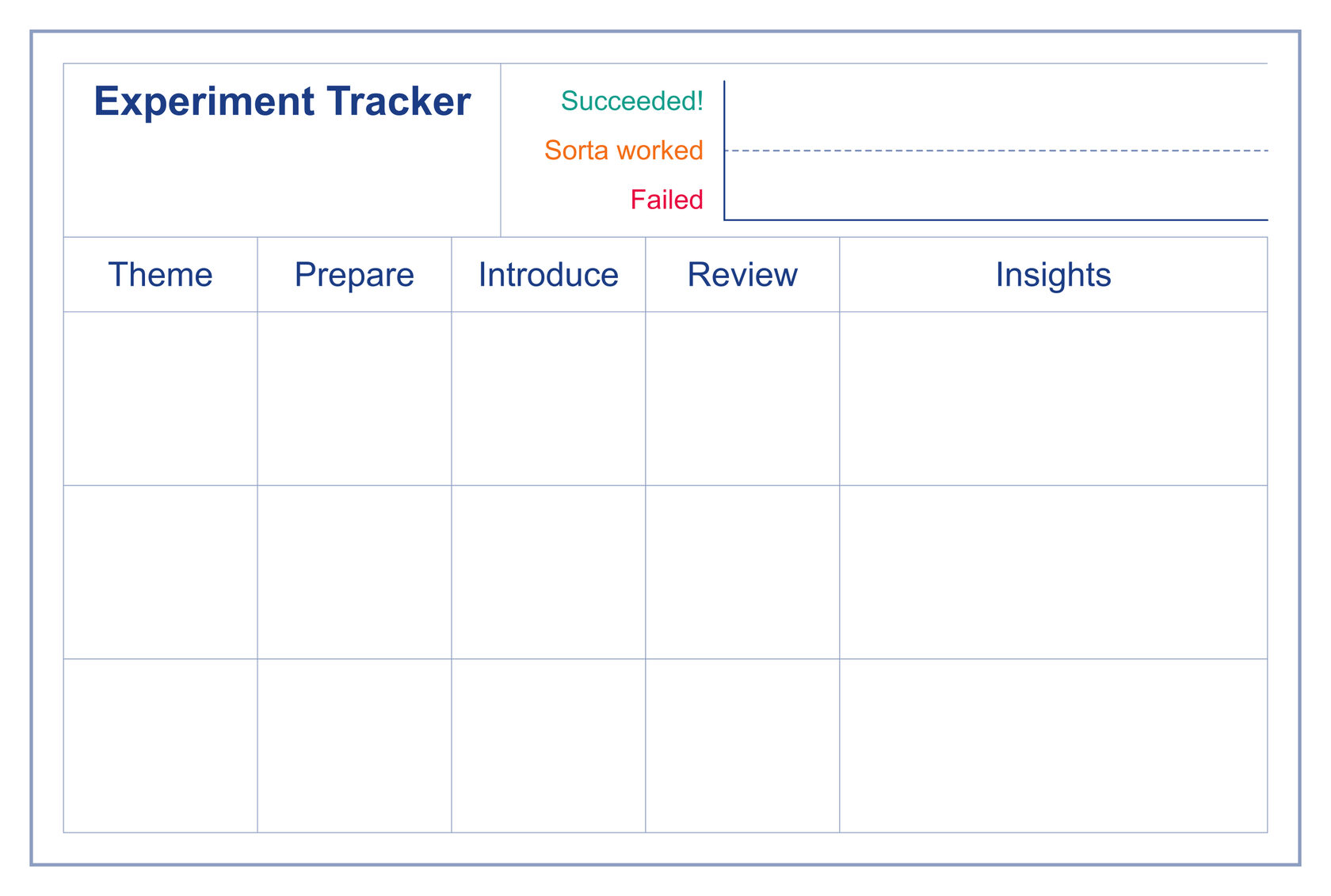
If you want a real answer to “what study music works for me,” run a simple 7-day experiment. The rule: change only one variable per day, so you learn something instead of collecting vibes.
Use this plan:
A simple notes template:
Task type:
Audio type:
Volume (1–10):
Pomodoros completed:
Mind-wanders (rough count):
Output (pages, problems, lines of code):
What I’d change tomorrow:
When you finish the week, keep the best-performing setup for your two most common tasks. That’s the version of “study music” that’s actually effective—because it’s proven in your context.
Make focus-friendly music in minutes
Turn a simple idea into a calm background track for reading, coding, or flashcards.