

House music is a groove-first form of dance music that usually feels warmer, more melodic, and more song-like than techno. The genre’s signature is a steady 4/4 pulse with swing, claps, hats, bass, and often chords or vocals that keep the track feeling human and uplifting. This guide breaks down the sound, BPM, subgenres, house vs techno differences, and a simple way to sketch a club-ready idea faster if you want to make your own.
From here, we move from the broad definition into the practical part: how to tell house from techno, which BPM ranges actually matter, and where MelodyCraft fits if you want to sketch a groove before you jump into a DAW.

What is house music (and what makes it feel so “danceable”)?
House music is a branch of electronic dance music that typically combines a steady four-on-the-floor kick drum with a rolling bass groove, syncopated hats, and harmonic elements (chords, stabs, or vocals) that add emotion. If you want a concise, historically grounded definition, Britannica’s overview of house music frames it as club-born dance music that grew from DJ culture and emerging electronic instruments.
The “danceable” feeling is not just the 4/4 time signature—it’s how the groove is organized so your body can predict what’s next while still getting tiny surprises. House often gives you:
A stable pulse (kick on every beat)
A bassline that “talks” to the kick (space + bounce)
Chords/vocals that act like a hook (emotion + memory)
Arrangements that evolve gradually (room for mixing)
A quick listening checklist (use this when you’re unsure what you’re hearing):
Drums: kick on all four beats; claps/snare commonly on 2 and 4
Bass: rounded, bouncy, repetitive motifs; often sidechained to the kick
Harmony: chord stabs, piano chords, pads, or jazzy progressions more common than in techno
Vocals: from soulful full verses to chopped phrases; vocals are “allowed” to be a main character
Section length: changes often happen every 8/16 bars, designed for DJ-friendly mixing

House music BPM: the typical tempo range and why DJs love it
Most house music sits around 118–128 BPM (with plenty of exceptions), which is fast enough to feel energetic but not so fast that dancers burn out quickly. That tempo window is also extremely DJ-friendly: it’s easy to beatmatch, easy to blend long transitions, and comfortable for layering acapellas or percussion loops on top.
The dancefloor impact is subtle but real:
Lower end (118–122): more sway, groove, and “head-nod”; great for warmups and deeper sets
Middle (123–126): the classic “all-night” zone; strong momentum without feeling rushed
Upper (127–128+): more push; closer to peak-time energy, and closer to some techno tempos
Same 4/4, totally different feel: a swung hat pattern at 124 BPM can feel “loose,” while straight 16ths at the same BPM can feel “stern.” Tempo is only the container—groove and sound design do the storytelling.
For context on how house evolved through scenes and eras, Orphiq’s history of house music is a useful way to connect tempo ranges with shifting club preferences.

The signature house groove: kick, clap, hats, and swing (what to listen for)
A classic house groove is basically a conversation between four roles: kick, clap, closed hat, and open hat—plus one magic ingredient: swing (also called shuffle). Here’s an 8-bar “listening route” you can follow in almost any house track:
Bar 1: lock onto the kick (boom-boom-boom-boom)
Bar 2: notice the clap on beats 2 and 4 (that’s your backbeat)
Bar 3: focus on the off-beat open hat (the “tss” between kicks)
Bar 4: listen for tiny timing pushes/pulls—hats that arrive slightly late create bounce
Bars 5–8: hear how percussion and fills appear briefly, then disappear (movement without chaos)
Mini follow-along exercise (takes 20 seconds):
Tap your foot on 1-2-3-4 (kick)
Clap your hands on 2 and 4
Whisper “ts” on the and between beats (1-&-2-&-3-&-4-&)
Now imagine the “ts” is a little late—that’s swing
The point: house groove is rarely about complexity; it’s about micro-feel. Two tracks can share the same drum placements and still feel totally different depending on swing amount, velocity, and sample choice.
Where did house music come from (Chicago roots and the culture behind it)?
House music is most famously rooted in Chicago club culture, where DJs and dancers shaped a sound designed for long nights, continuous mixing, and emotional release. If you want a credible snapshot of the key artists and moments, the GRAMMY.com house music timeline is a helpful map—but the culture makes more sense when you picture three scenes playing at once.
Scene 1: The DJ as editor. Instead of treating a record as “finished,” DJs extended, blended, and re-contextualized tracks to fit the room. The craft wasn’t only selection—it was control of energy over time.
Scene 2: The dancefloor as feedback. House developed as a response to what moved people physically and emotionally: steady kicks, infectious bass, and harmonies that could feel hopeful, sensual, or cathartic at 3 a.m.
Scene 3: The tools as instruments. Drum machines, samplers, and affordable synths weren’t just cost-saving; they created new textures that live musicians didn’t naturally play—tight claps, mechanical hats, and loop-based hypnosis.
The result is a genre that’s both functional (built for mixing) and expressive (built for feeling).
A quick house music timeline: key moments that shaped the genre
Below is a beginner-friendly timeline you can use to connect “what you hear” to “when it happened.” (You don’t need to memorize names—focus on the sound shifts.)

House music subgenres beginners actually search for (deep house, tech house, acid house, progressive)
If you’ve heard “house music” on a party clip or a short video, the real question is usually: which kind? Here’s a practical way to think about subgenres—organized by what you’d notice first in a real-life setting.
A useful rule: as you move from deep → tech → acid/progressive variants, you often get either less traditional harmony (tech) or more obvious “signature synthesis” (acid), while arrangements stay DJ-friendly.
Deep house vs tech house: how to tell them apart in a DJ set
Deep house and tech house get confused because both live in similar BPM ranges and both love repetition. Use these four “DJ set” cues instead:
Harmony density:
Deep house: chords/pads are a main layer
Tech house: harmony is minimal or implied
Vocal presence:
Deep house: soulful phrases or melodic vocal lines
Tech house: short spoken hooks, chops, or callouts (often rhythmic)
Drum character:
Deep house: rounder kick, softer clap, more air
Tech house: harder transients, tighter clap, more percussion “ticks”
Low-end engine:
Deep house: bassline “bounces” and feels musical
Tech house: bass is more “rolling” and functional—built to push momentum
Common misread: a track with jazzy samples but very tight, aggressive drums can feel deep at first—until the groove reveals a more percussive, tool-like structure typical of tech house.
Acid house essentials: the sound that still fuels club music today
Acid house is built around one instantly recognizable idea: the acid bassline—a resonant, squelchy synth pattern that changes character when you sweep a filter. Even if you don’t know the instrument history, you can hear it as a “talking” bass that bubbles, bites, and morphs without needing new notes.
Why it still matters for modern club music: acid is a shortcut to motion. One repeating line can carry a whole room because the timbre evolves, creating tension and release without changing the chord progression. That concept—movement through sound design instead of harmony—is now common across house, techno, and hybrid club tracks.

Need a faster way to sketch house tracks?
Turn groove, BPM, and mood into a usable draft in MelodyCraft in minutes.
House music vs techno: the 60-second checklist (groove, harmony, sound design)
House music vs techno is confusing because both can be 4/4, both are built for DJs, and both live in adjacent BPM ranges. The fastest way to tell them apart is to listen for what the track is prioritizing: harmony and uplift (house) or texture and drive (techno).
For a complementary breakdown, Splice’s guide on house vs techno aligns well with what DJs listen for in the first minute.
60-second checklist (listen in this order):
Groove: does it swing and bounce (house) or march and push (techno)?
Harmony: do you hear chord stabs/piano/vocal emotion (house) or minimal tonal content (techno)?
Sound design: does the movement come from musical parts (house) or evolving textures/industrial layers (techno)?
Breakdowns: are they song-like with hooks (house) or tension-focused with subtle changes (techno)?
Mood goal: “uplifting / soulful / playful” (house) vs “hypnotic / intense / mechanical” (techno)

Why techno often feels more “driving” (and house more “uplifting”)
Techno often feels more driving because it increases repetition density: more elements hit more often (percussion loops, rumble layers, repeating synth ticks), and the changes are smaller but more constant. House, by contrast, often leaves more space for harmonic emotion—a chord change, a vocal phrase, a piano riff—so the energy can feel brighter or more “human.”
A practical way to hear the difference:
Warm vs cold timbre: house leans warm (rounded bass, soulful samples); techno often leans cool/metallic (noisy hats, industrial textures)
Chord progression: house may use real progressions; techno may sit on one tonal center and evolve the texture instead
Vocal percentage: more vocals usually pulls you toward house
Tension/release: techno stretches tension longer, then pays off bigger at the peak
If your goal is a peak-time, pressure-cooker dancefloor moment, techno techniques (texture, long builds, restrained harmony) are often the more direct toolkit.
What does “club music” mean—does it just mean house and techno?
“Club music” is usually a context word, not a single genre. It means music designed to work in a club environment: consistent tempo, mix-friendly structure, and energy that translates on a big system.
So no—club music doesn’t only mean house music and techno, even though those are two of its biggest pillars. Depending on scene and era, “club music” might also include garage, trance, drum & bass, dance-pop edits, breakbeat, and other DJ formats. The label is less about sound rules and more about function: does it support a DJ set and a dancefloor arc?
Club music starter pack: the 5 cues DJs use to label a track fast
When DJs sort tracks quickly, they’re often using a mental tagging system. Here are five cues that can help you label tracks in under 30 seconds:
BPM range: not the whole story, but it narrows the lane fast
Drum pattern: swingy house hats vs straight techno grid vs breakbeats
Breakdown length: short utility breaks vs long cinematic sections
Drop intensity: gentle groove return vs hard “slam” moment
Sound palette tags: “piano,” “acid,” “rumble,” “tribal,” “vocal,” “minimal”
Practical “set placement” trick: ask where it fits—warmup, mid-set, or peak. Even within house music, a warm deep house roller and a peak tech house banger behave differently in a room.
How to start listening to house music (without getting lost in playlists)
To get into house music without drowning in endless playlists, use a simple three-choice path: pick a subgenre → pick a decade → pick a scenario. That gives you a clear filter for what to search and what to skip.
1) Choose one subgenre for a week (deep, tech, acid, progressive). 2) Choose one era (80s roots, 90s expansion, 2000s/2010s club evolution). 3) Choose one setting (work focus, gym, pregame, late-night headphones, club peak).
Then search for directions like these (no links—just type and explore):
Frankie Knuckles classic mixes
Larry Heard / Mr. Fingers deep cuts
Marshall Jefferson piano house anthems
Chicago house classics compilation
90s deep house classics
UK house 90s/00s essentials
Minimal tech house rollers
Acid house classics (TB-style bass)
Progressive house early 2000s
Modern vocal house club edits
If you like understanding the “why” behind what you’re hearing, pairing your listening with a timeline-style read (like the GRAMMY.com house music timeline) makes the subgenres click faster.
How to make a basic house music beat in 15 minutes (step-by-step)
You can build a usable house music loop fast if you focus on foundations first: kick + clap + hats + bass, then add chords and a DJ-friendly arrangement. Here’s a 15-minute workflow you can replicate in any DAW.
1) Project setup (1 minute)
Tempo: 124 BPM (safe “classic house” starting point)
Time signature: 4/4
Loop length: 8 bars
2) Kick (2 minutes)
Place a kick on every beat (1, 2, 3, 4)
Choose a kick with a clean low end; avoid a long boomy tail at first
3) Clap/snare (2 minutes)
Put claps on beats 2 and 4
Slightly vary velocity (one clap can be a touch louder)
4) Hats + groove (4 minutes)
Closed hat on 8ths or 16ths
Open hat on off-beats (the “&” between kicks)
Add swing: start around 52–58% (DAW-dependent)
5) Bassline (3 minutes)
Use a simple 1–2 bar motif that repeats
Sidechain or manually duck the bass so the kick stays clear
6) Chords/stabs (2 minutes)
Add a short chord stab (piano or organ works)
Keep it rhythmic; don’t fill every gap
7) Micro-arrangement (1 minute)
Bars 1–2: drums only
Bars 3–4: add bass
Bars 5–6: add chords
Bars 7–8: add a small fill or extra percussion
If your loop feels “flat,” don’t add more sounds first—add groove: small velocity changes, tiny timing shifts, and swing usually fix it faster than another plugin.
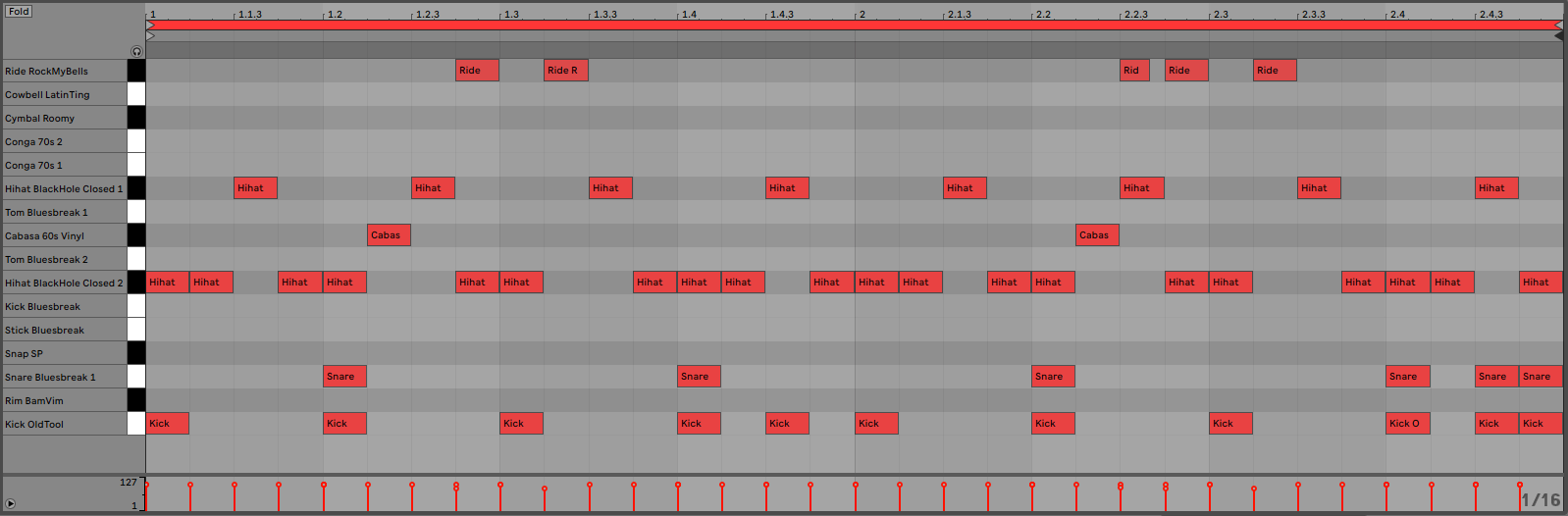
The classic house drum pattern (kick/clap/hat) you can reuse forever
Here’s a default template you can save as a starting point:
Kick: quarter notes (every beat)
Clap/Snare: beats 2 and 4
Closed hat: 8th notes (or 16ths for more energy)
Open hat: off-beats (1&, 2&, 3&, 4&)
To make it feel human without getting messy:
Nudge some hats a few milliseconds late (or increase swing)
Alternate hat velocities (e.g., loud-soft-loud-soft)
Add a very quiet ghost percussion hit once every 2 bars
House basslines and chord stabs: a simple progression that works
House arrangement is often about making the low end and harmony share space. If your kick is strong at 50–100 Hz, your bass can emphasize slightly above (or duck under) it, and your chords should avoid muddy low mids.
Two dependable harmonic approaches:
Classic pop-friendly uplift: I–vi–IV–V (bright, familiar, vocal-friendly)
Deeper/minor mood: i–♭VII–♭VI–♭VII (hypnotic, emotional, loopable)
Practical voicing tips:
Keep chord stabs short (reduce sustain), so they don’t blur with the bass
High-pass chords/pads so they don’t fight kick/bass
If bass is busy, make chords simpler; if chords are rich, make bass simpler
How to adapt the same loop into techno (harder drums, fewer chords, more texture)
Turning a house loop into techno is mostly subtraction + texture. You reduce harmonic storytelling, tighten the grid, and build intensity through layering and evolution. If you want a broader overview of techno styles and sound cues, this techno explained guide is a solid reference for what producers mean by “driving” or “industrial.”
Use this “house → techno” conversion checklist:
Reduce chords: swap chord stabs for one-note riffs, drones, or filtered noise
Harden drums: tighter kick, sharper hats, more consistent velocity on core hits
Add texture loops: rumble, metallic percussion, room noise, vinyl/air layers
Increase repetition density: more small percussive events per bar
Lengthen sections: fewer obvious hooks; more gradual transitions over 16–32 bars
Automate movement: filters, distortion, reverb size, delay feedback—slow changes that add tension
Different techno substyles often come from tweaking only 2–3 “knobs”:
More rumble + darker hats = heavier/warehouse
Brighter percussion + faster BPM = more peak/modern
More minimal layers + more space = hypnotic/minimal techno
Techno arrangement basics: longer builds, smaller changes, bigger payoff
A reliable techno writing habit is: every 8 or 16 bars, change one thing—not five. The power comes from restraint.
Try this template on your converted loop:
0:00–0:45: kick + hats, introduce one texture layer
0:45–1:30: add bass/rumble, tiny automation on filter or distortion
1:30–2:15: add one new percussive loop; remove a hat to create contrast
2:15–3:00 (peak): bring back the missing element, open the filter, increase density
3:00–end: subtract elements for a DJ-friendly exit
The “payoff” works because the listener has been trained by repetition—so a small change feels huge.
Generate a club-ready demo faster with MelodyCraft (house vs techno prompt templates)
When you’re learning house music and techno, the hardest part is often not the theory—it’s getting from “I kind of hear it” to “I have a demo I can iterate on.” That’s where MelodyCraft can help: it’s a fast way to generate draft ideas (grooves, structure, mood) so you can spend your time editing like a producer instead of staring at an empty project.

Below are three copy-paste English prompt templates you can tweak:
1) House (classic/uplifting)
Prompt:
Create a 124 BPM house track with four-on-the-floor kick, claps on 2 and 4, swung hats, warm bassline, and bright piano chord stabs. Add a short vocal hook and DJ-friendly 16-bar intro/outro.
2) Tech house (club tool)
Prompt:
Generate a 126 BPM tech house groove with tight punchy drums, rolling bass, minimal chords, and short chopped vocal phrases. Keep sections loopable with subtle fills every 8 bars and a clean breakdown into a strong drop.
3) Techno (driving/hypnotic)
Prompt:
Make a 132 BPM techno track with hard kick, straight hats, evolving rumble layer, metallic percussion, minimal melodic content, and slow automation that increases intensity over long 16–32 bar builds.
What to export/check before sharing your track (length, intro/outro, mix balance)
Before you send your track to friends, a DJ, or social media, you’ll get better feedback if you export something that behaves like club music—even if it’s still a demo.
Use this pre-share checklist:
Length: 2:30–5:00 is fine for demos; longer if it’s DJ-oriented
Intro/outro: include at least 16 bars of mixable drums (especially for house music and techno)
Peaks: leave headroom; avoid clipping on the master
Low end: kick and bass should not fight—check on small speakers and headphones
Space: don’t fill every frequency; a little “air” makes it sound more professional
File format: WAV for DJ/producer friends; high-quality MP3 for quick sharing
If you’re choosing between export needs (more drafts, higher limits, different workflows), check what’s included on MelodyCraft pricing so your plan matches how often you iterate.
What to do next: pick your house lane, then learn techno by contrast
If you want progress you can feel in a week, keep it simple and measurable:
1) Pick one house lane (deep, tech, acid, progressive) 2) Pick one BPM and stick to it for 7 days 3) Make one 8-bar house loop using the drum template above 4) Make one techno version of the same loop (remove chords, add texture, lengthen changes) 5) A/B them daily—your ears will learn faster than your notes
Common sticking points (quick fixes):
Q: Why doesn’t my loop feel “groovy” even though the pattern is right?
A: Add swing, then adjust hat velocities. Groove usually comes from timing/velocity—not extra layers.
Q: My kick and bass sound muddy. What should I do first?
A: Shorten the bass notes, high-pass chord stabs, and add gentle sidechain (or manual ducking) so the kick consistently wins the transient.
Q: My techno version sounds empty after I remove chords.
A: Replace harmony with texture movement: a rumble layer, filtered noise, or evolving reverb/delay automation can carry energy without “chords.”
Make house-ready music faster
Go from idea to a draft you can refine for playlists, sets, or content clips.